

Bilt's Micro-Sitcom Lives Rent Free
A credit card company made a perfectly fine sitcom and why that's way more impressive than it sounds

At a recent work event, I was cajoled into sharing my hottest take about social media and ended up giving a podcast-length answer about the future of comedy.
Three glasses deep on free natural wine, I outlined a brave new world for comedy writers, one where social media resembles variety shows from the 1940s, like your Colgate Comedy Hour, where brands are the exclusive sponsor and shows are developed far, far, far away from whatever is left of the studio system. I was convinced I was alone in thinking this, but turns out, I’m not!
Historically, advertising has been a safe place for comedy writers to make some cash while protecting their bottom line as they Make Their Dreams Come True™. A bunch of comedians have actually floated in and out of advertising. Jim Gaffigan started at Ogilvy & Mather, Tim & Eric had their now legendary Old Spice run, and Ryan Reynolds is a better marketer than actor at this point. But with the collapse of the entertainment industry, where can comedians work if not in advertising?
Let’s stop separating advertising comedy from “real” comedy. It’s all comedy, all the same magic trick, and it’s one that I love and think about constantly.
Which brings us to a sitcom made by a credit card company.
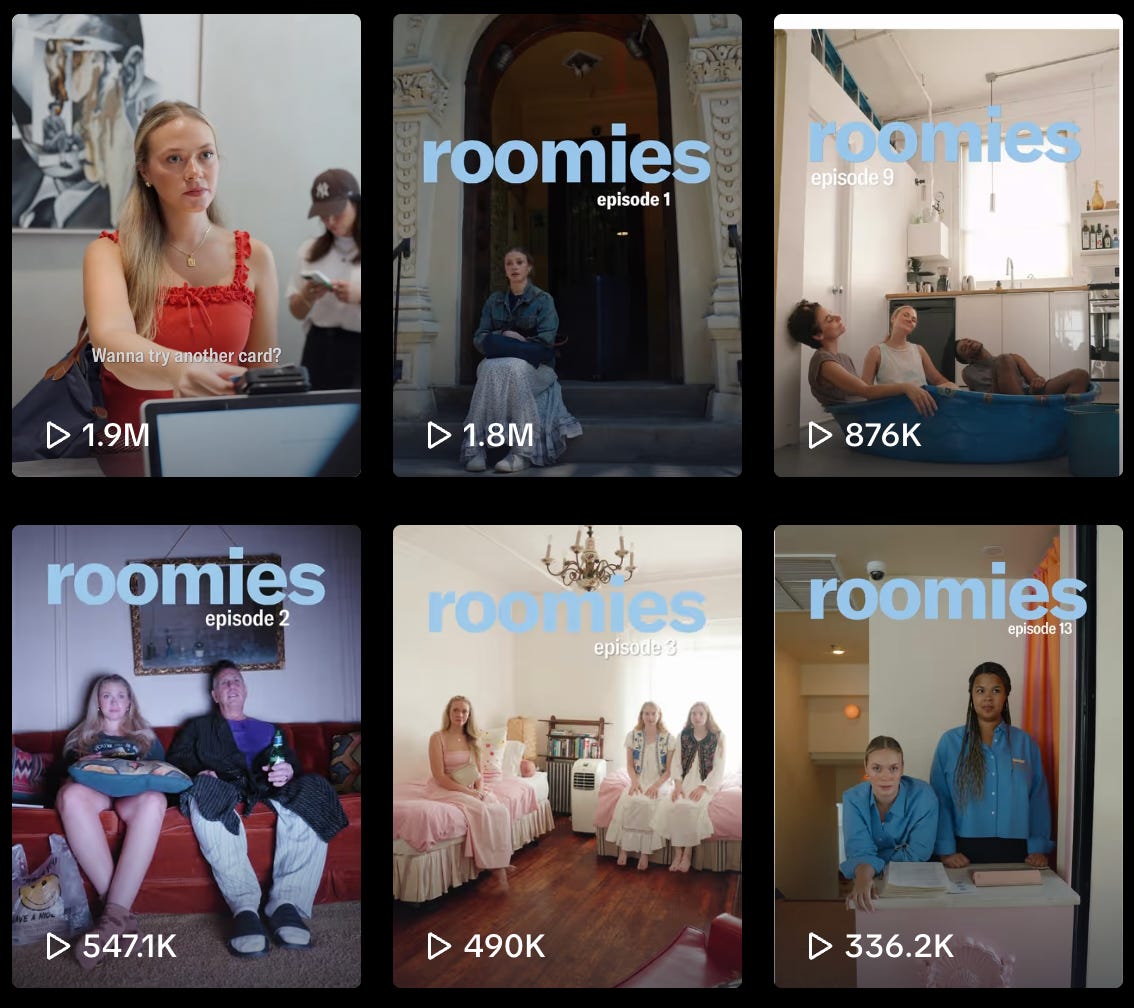
Roomies is a single-camera, Mike Schur-style sitcom, complete with to-camera confessionals, a yappy cast of approachably hot people, and a four-bedroom loft where characters can reliably crash into each other.
Produced entirely by Bilt, a credit card company that lets you earn points on paying your rent, this is, to my knowledge, the first serialized story entirely funded by one singular brand since Procter & Gamble invented the Soap Opera.
Roomies has been covered a lot, but I’d argue still not enough. I want to focus on two important questions.
Is it funny?
Does it do shit for the brand?
Roomies, Roomies, Roomies
The show itself follows four roommates, each a familiar Gen Z archetype. Ellie is the blonde, basic, and Midwestern Swiftie. Ovie is the too-smart indoor kid with some codependency issues. Rain is the slightly left-of-heteronormal creative. And Griffin is the hustle-culture bro with a heart of gold.
If you asked ChatGPT to summarize every episode of 30 Rock, filter it through the logline of Friends, and compress it into three to five pages of shooting script optimized for algorithms, you would get something close to Roomies. Binge-watching it was surprisingly fun, and I walked away actually caring about these characters.
Post-The Office, the quality of a sitcom is now measured in joke density. How many crackling one-liners can you cram into 22 minutes? On TikTok, which is the best platform to binge Roomies for reasons I can’t fully explain, the show averages just over two minutes per episode, but even with that limitation, Roomies finds a rhythm and serves enough jokes to cover the spread.
That said, when Roomies whiffs the ball, you notice it. Bits of dialogue can suddenly kill the otherwise propulsive momentum, and actors will sometimes dictate their lines instead of performing them. Every episode tends to have a batch of jokes that clearly read better than they sound.
With only two minutes to fill, comedic bald spots should not be a problem, but fortunately, they’re rare.
I’m old enough to remember the heyday of web series in the early aughts, when every young actor/director/writer tried to make a sitcom with their Canon 7D. Outliers like Issa Rae’s The Misadventures of Awkward Black Girl, Abbi Jacobson and Ilana Glazer’s Broad City, and Ben Sinclair’s High Maintenance turned web series into legit TV careers. Still, for hundreds of others, most were either really boring or really bad.
But that was 2008, and almost twenty years later, the education necessary to get shit to look and feel good is more available than ever. Roomies avoids most amateur pitfalls because the knowledge to light a scene is a YouTube search away.
Also, the writing is just good.
In Episode 9, Ellie has to solve for a broken A/C and buys a kiddie pool from Duane Reade. The line “I knew they would have one! And it wasn’t even locked up!” is as strong and biting a joke as I could ask for.
Episode 12, which boasts a fucking wild 1.9m views on TikTok, features a job-hunt-induced primal scream from Ellie that works as not just a great joke, but a revealing piece of character development that’s elegant in the way only a good comic actress can pull off.
And in Episode 6, we get a pretty good Mike Schur-esque shmatlzy knock-off via Griffin, “When you live with people for a while, you almost forget that they’re separate from you. You don’t realize they’re part of their everyday. How they influence you.”
Leslie Nope, that you?
After 14 episodes, I am shocked at how comfortable it is to live with Roomies.
Bilt, Bilt, Bilt
The real question is, is Roomies doing any favors for Bilt? Not once is the product mentioned or even used throughout the run (so far), and in an act of incredible restraint, the only branding is a tiny message in the bio: “New episodes weekly by @Bilt.”
There is a version of this show where Ovie, a programmer for apps, works at Bilt, talks about Bilt every 15 seconds, and the Bilt logo is somehow in every shot. The fact that there is not a single moment in this show that feels like a commercial is a testament to the level of faith Bilt has in this series, which I’m almost a little worried about.
How in the fuck is anyone supposed to know what Bilt is or that they should use it? If there’s no logo to make bigger, does marketing even exist?
Over on Bilt’s hero social channels, we get a clearer picture.
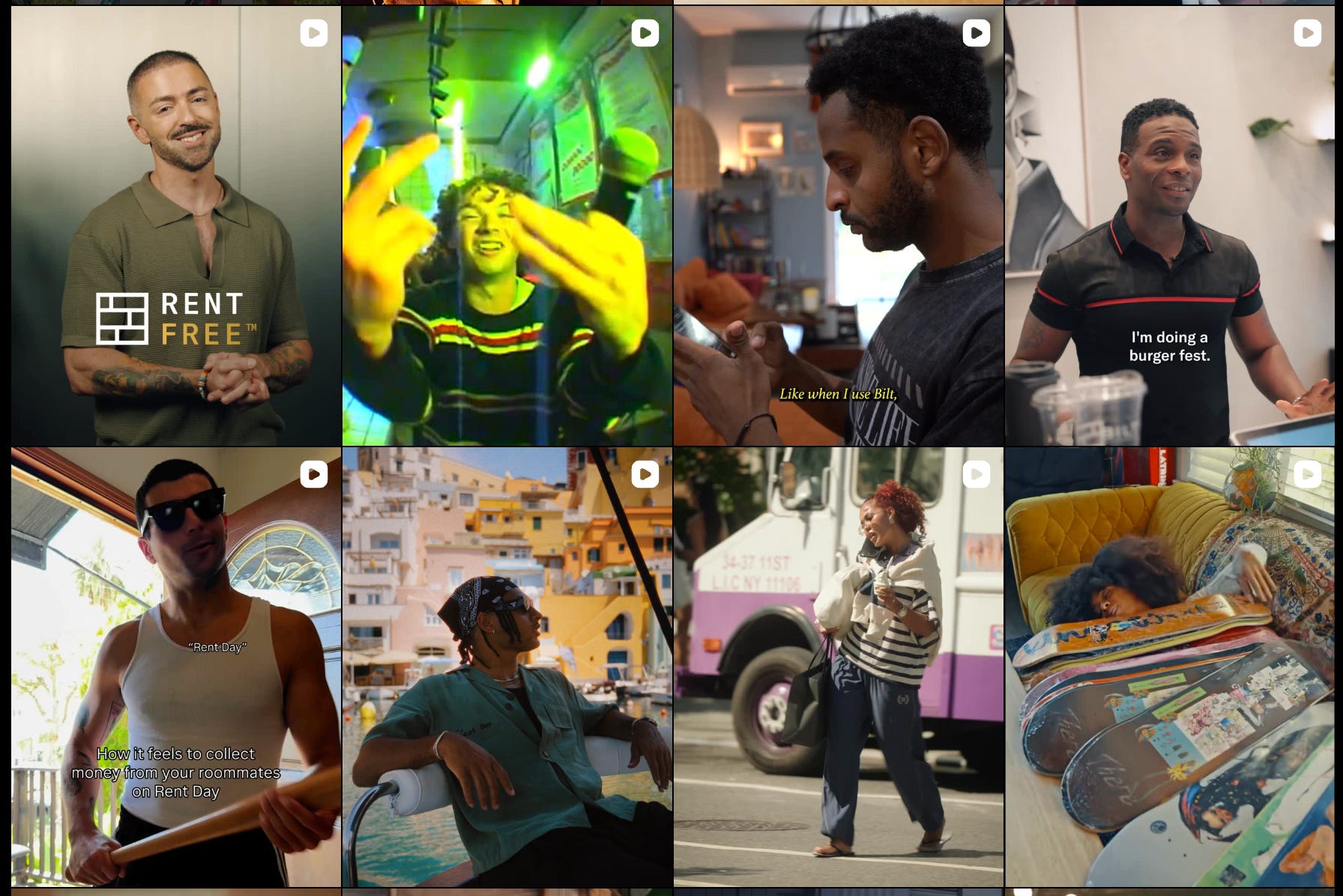
On Instagram, their preferred platform, you’ll see not just the voice of the brand but who they believe is their ideal customer. Someone young, most likely dating around, living in a city, and importantly, has good enough taste to want expensive shit but probably can’t afford it. Y’know, like someone who’d want to earn points on the thing they spent more than 30% of their income on. Like you and your roommates.
Bilt has clearly gone all in on comedy. Take Rent Free, a series where popular comedians share what lives rent-free in their brains. It’s a smart idea that ladders back to the brand’s goals so easily, it’s insane that this is the first time I’ve seen it.
Everything is shot with a Premium Instagram LUT, their social leans on comedy cred in a smart, modern way, and they are clearly investing in activations and community building that make sense for their audience.
So does a regular-ass sitcom count as a brand extension, the same way a capsule collection might?
I ran the idea past a friend who works in social media branding. She didn’t give me a straight yes on whether Roomies helps Bilt’s brand, but she pointed out something else: because the show is genuinely funny and the characters feel real, the next time she sees a Bilt ad in the wild, that parasocial glow from Ellie, Rain, Ovie, and Griffin could spill over into goodwill for a credit card company.
Sounds like a win to me.
If all branding is lifestyle branding, why not make content for the casual comedy fan? The broke 20-something bingeing Friends or Parks & Rec. Lifestyle branding usually screams luxury, elitism, and aspiration. When was the last time a brand acknowledged its customers’ reality, working too much, still broke, and just trying to afford a little treat?
Interesting read, Jesse. I wonder if you could go one layer deeper with the math that went into Bilt's decision to greenlight this "campaign". For instance, if each episode costs ~$10K to make, how many people need to sign up and be a Bilt rewards member for X years, before they recoup the cost of production?